
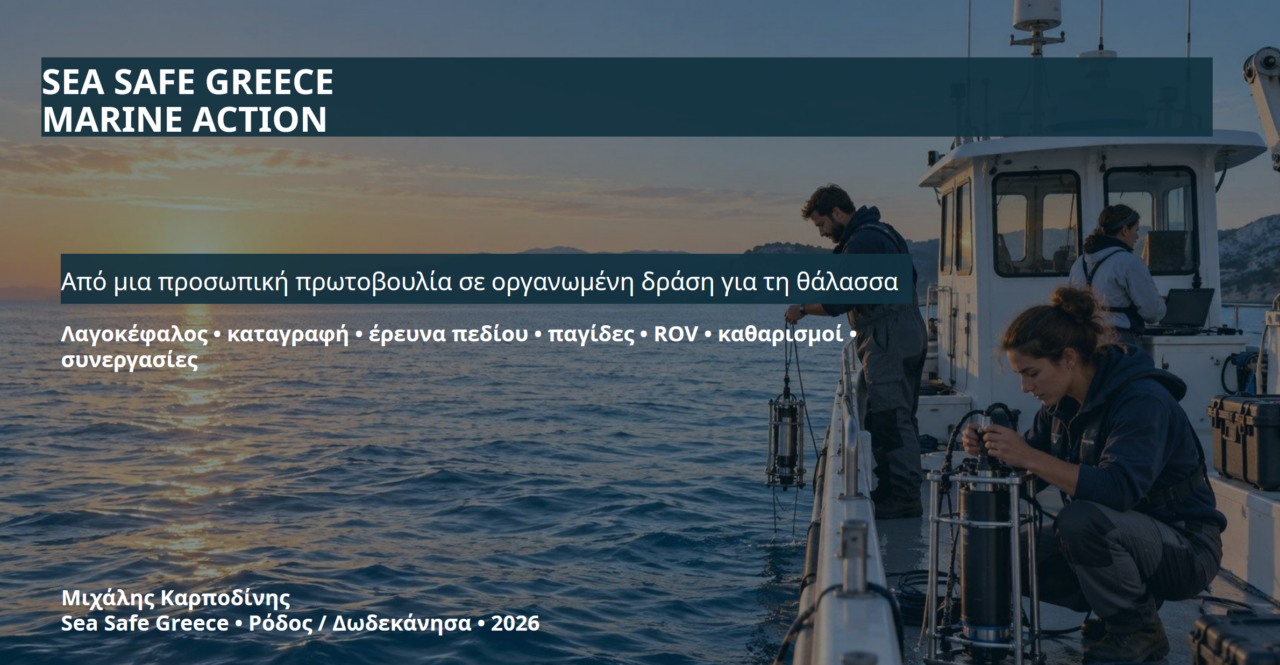
SEA SAFE GREECE MARINE ACTION is issuing an open call to businesses, hotel chains, professionals, organizations, and citizens of Rhodes to help make the first organized pilot program for the study and controlled trapping of Lagocephalus sceleratus—the rabbitfish—a reality.
At the same time, this effort is now expanding to a broader scale. SEA SAFE GREECE aims to create an active group of people who are genuinely interested in the seas around Rhodes and want to participate, each in their own way and to the best of their ability. You don’t have to be a scientist, a diver, or a professional fisherman. You can contribute your time, knowledge, technical assistance, equipment, transportation, participation in cleanups or surveys, or simply take on a specific part of an initiative.
Our initial trials showed us that it’s worth moving forward
The effort to save the flounder didn’t start just on paper. Prior to official authorization, the SEA SAFE GREECE team built and tested the first experimental versions of specialized cages—traps.
These tests were unofficial and on a limited scale, but the initial results were particularly encouraging. The first cages demonstrated in practice that the basic concept has potential and that it is now worth examining in an organized, official, and scientifically documented manner.
This was the point that led SEA SAFE GREECE to decide to take it a step further: to apply for an official research permit and design a new, more sophisticated version of the cage, building on what we learned from the initial tests. Today, we are working on developing this system, with the goal of improving its functionality, ensuring safer use, enabling systematic underwater monitoring, and achieving the greatest possible selectivity toward the rabbitfish.
From Informal Testing to Formal Research
SEA SAFE GREECE has now received an official research permit from the Ministry of Environment and Energy to study the concentration, attendance, behavior, and controlled trapping of the rabbit-headed lizard.
The permit was issued on September 4, 2026, with Ref. No. YPEN/DDD/96507/3177 and ADA RYXΔ4653Π8-Ι8Ω, with priority given to Rhodes and the possibility of conducting activities on Karpathos and Kastellorizo as well.
The next step is to construct the advanced research cages and move on to organized field implementation using underwater cameras, ROVs (remotely operated underwater vehicles), geographic mapping, monitoring of non-target species, repeated observations, and actual data that can be scientifically evaluated.
We do not claim that a definitive solution to the rabbitfish problem has already been found. This is precisely what we want to investigate: to determine, using official and measurable data, whether a method that has shown very promising initial results can develop into a truly useful management tool.
An initiative that affects all of Rhodes and its tourism sector
The marine environment is one of the most important elements of Rhodes’ identity and economy. This relationship is not limited to just one area of the island.
On the eastern and southeastern sides, from Faliraki and Kolymbia, continuing on to Lindos, Pefkos, Kiotari, Gennadi, and Lachania all the way to Prasonisi, lie some of Rhodes’ most important tourist and coastal areas. Similarly, on the western side, areas such as Ixia and Ialysos, along with the coastal zone around the city of Rhodes, also feature intense hotel and tourist activity.
In all these areas, the sea is an integral part of the island’s tourism offering: beaches, swimming, diving, water sports, day trips, recreational boating, and coastal businesses all depend directly on the quality and image of the marine environment.
That is why the protection and systematic monitoring of the sea are not merely environmental issues. They are also matters of sustainable tourism development on Rhodes. A coordinated approach to addressing problems such as invasive species, abandoned fishing gear, and marine pollution can benefit both the natural environment and the island’s overall tourism image.
SEA SAFE GREECE doesn’t stop at the rabbitfish
This specific pilot project is currently our most advanced initiative, but it is part of a broader plan. SEA SAFE GREECE MARINE ACTION is organized so that it can gradually participate in:
- coastal and marine cleanups,
- locating and documenting abandoned nets and other fishing gear,
- organized operations to address ghost nets (abandoned or lost nets), where conditions and permits allow,
- underwater monitoring using ROVs,
- recording of alien and invasive species,
- mapping of areas of interest,
- collaboration with fishermen and divers,
- public awareness and education,
- and broader actions to protect the marine environment.
Cases of abandoned fishing gear have already been identified and may be the focus of future organized actions.
We’re not just looking for sponsors—we’re looking for people
For such an effort to be sustainable, equipment alone is not enough. We also need a team.
SEA SAFE GREECE MARINE ACTION invites people from Rhodes and the Dodecanese who want to participate in this effort to contact us and join the team.
You can help with cleanups, diving, boat and maritime operations, fishing, technical construction, machinery and tools, photography and video, underwater documentation, IT and mapping, communications, event organization, scientific support, or simply by helping with a specific volunteer activity.
No one needs to be able to do everything. We need people who can help, even if it’s just with one aspect.
To make this first step a reality, we need Rhodes’s help
The basic concept has already been tested. The initial results were very encouraging. The official permit has been granted. The advanced version of the system is being designed.
What is needed now is support to build and test it systematically at sea. The requirements include, among other things, the construction of research cages, metal materials and technical labor, underwater cameras and telemetry, ROVs and monitoring equipment, sonar and mapping, deployment and recovery equipment, fuel and expedition costs, diving and technical equipment, and operational support.
Assistance may be financial, but it is not limited to that. It can take the form of equipment, materials, services, technical work, transportation, fuel, professional expertise, or personal volunteer participation. Every contribution is important.
“We want to build a team that will stick around.”
“The first cages we tested informally yielded very good results, and that’s what led us to decide that we needed to move forward seriously and officially.
Today we have the permit and are working to build an advanced version of the system so we can test it using data logging, cameras, and real-world data.
However, we at SEA SAFE GREECE don’t want this to be just an initiative focused on the rabbitfish. We want to create a team that can be there whenever help is needed at sea: for a cleanup, to deal with an abandoned net, to conduct data collection, or to carry out an underwater survey.
And no one needs to be able to do everything. If someone can help with just one part, that’s important to us.
We want this effort to get off to a strong start in Rhodes and to truly belong to the people who care about the island’s sea.”
Open Call for Collaboration and Participation
SEA SAFE GREECE MARINE ACTION invites hotel and tourism businesses from all tourist areas of Rhodes that wish to support the first pilot project, as well as local businesses, professionals and organizations that can provide equipment, services, or technical support, as well as citizens who wish to become members or volunteers of the team, to contact us.
Protecting the sea is not the responsibility of a single person or a single area of the island. It is a shared responsibility for all of Rhodes.