
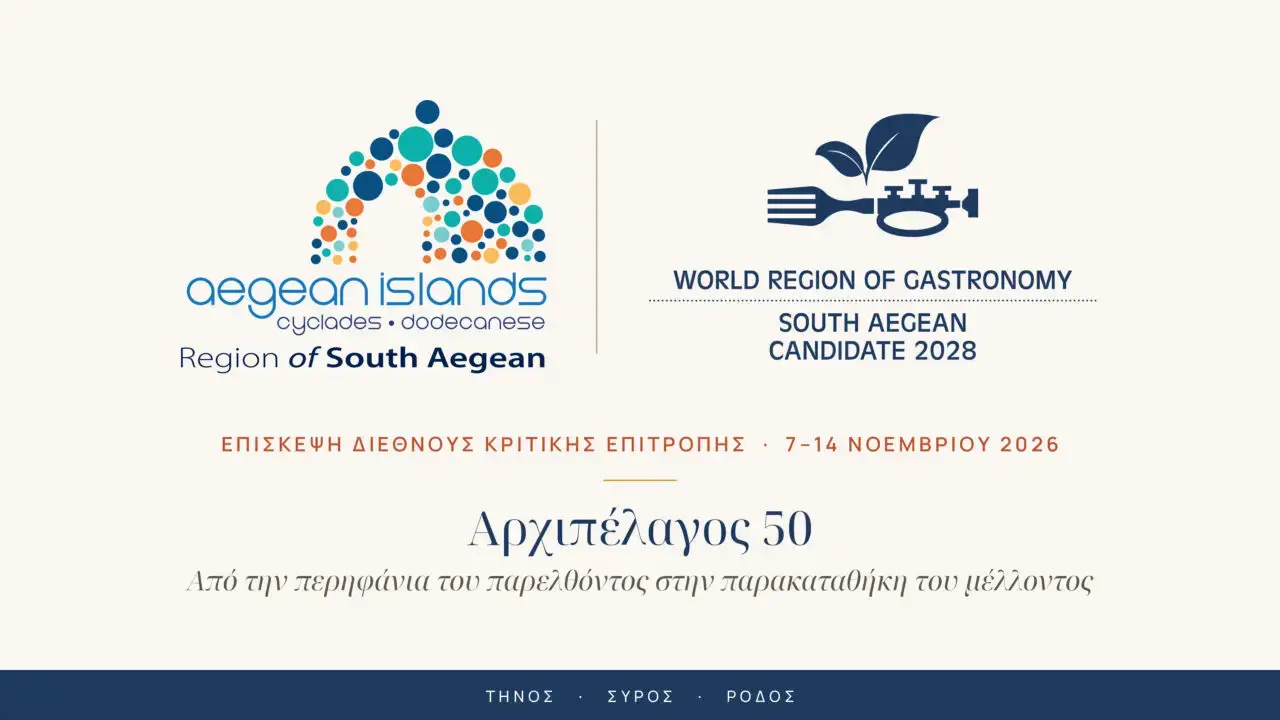
The South Aegean Region will host the international jury of IGCAT (International Institute of Gastronomy, Culture, Arts, and Tourism) from November 7 to 13, 2026, as part of the evaluation of its candidacy for the title “World Region of Gastronomy 2028.”
The Region of South Aegean, the first Greek region to vie for this title, has undertaken the planning, organization, and overall coordination of the visit, mobilizing a broad network of institutional bodies, producer organizations, businesses, educational and scientific institutions, cultural associations, and representatives of civil society.
The seven-day program, with stops in Tinos, Syros, and Rhodes, includes visits, institutional meetings, presentations, and hands-on activities. The goal is for the committee to become acquainted not only with the islands’ culinary richness but also with the entire ecosystem that links primary production with culture, education, tourism, entrepreneurship, innovation, and sustainable development.
Archipelago 50 – Where Diversity Becomes Identity
The South Aegean’s bid is built around the central concept “Archipelago 50 – Where Diversity Becomes Identity” and the slogan “From the glory of the past to the legacy of the future.”
In a region comprising 669 islands and islets, 50 of which are inhabited, geographical dispersion and diversity are not an obstacle to the formation of a shared identity but rather its very source. Each island has its own history, its own flavors, its own crops, its own techniques, and its own traditions. Together, they form a vibrant gastronomic culture, shaped by people’s long-standing relationship with the land, the sea, and the available natural resources.
The philosophy behind the nomination views gastronomy as a meeting point of the economy, culture, society, and the environment. From the protection of local varieties and sustainable fishing to the preservation of traditional knowledge, the support of young producers, and the integration of local production with tourism, gastronomy serves as a tool for sustainable development and the empowerment of island communities.
The Regional Governor of the South Aegean, George Hatzimarkos, stated:
“We welcome the IGCAT judging panel in the same spirit with which we built our candidacy: we want them to see our islands as they truly are, through their people. The farmer who keeps a variety of crops alive. The young person who returned to his or her island to build something of their own. The woman who teaches her grandchildren the recipe she learned from her mother. This is the gastronomy of the South Aegean. In 2019, the South Aegean was named a European Region of Gastronomy. Today, as the first Greek region to vie for the global title, we believe that the experience of our islands has something to say even beyond our borders: how small communities, with limited resources, can turn their traditions into an asset and a source of opportunity. None of this would be possible without cooperation. I would like to extend my warmest thanks to the Chambers of Commerce of the Cyclades and the Dodecanese, the organizations, the producers, and everyone who has opened their doors to the committee, as well as to the Attica Group for its support. Fifty islands, one voice.”
Three Island Stops – Three Different Facets of the Same Identity
Tinos | November 8–10 – Tradition, land, and local production
The committee’s first stop is Tinos, where the Deputy Prefect of Tinos, Anastasia Deligianni-Aspro. The program focuses on the relationship between gastronomy and the rural landscape, traditional know-how, and cultural heritage. The delegation will explore local produce, the art of marble carving and dry-stone walling, as well as contemporary initiatives that connect the land with culinary creation.
Syros | November 10–11 – Entrepreneurship, Production, and Institutional Collaboration
In Syros, the administrative capital of the South Aegean, the program highlights the connection between gastronomy and entrepreneurship, manufacturing, cultural heritage, and the new generation of producers. The committee members will be welcomed by the Deputy Regional Governor of the Cyclades, George Leontaritis, who will hold a press conference at the Regional Administration offices in Ermoupoli, in the presence of members of the Regional Council. The program includes a visit to the Cyclades Chamber of Commerce, meetings with institutional representatives, and visits to production facilities and cultural sites on the island.
Rhodes | November 12–13 – Regional strategy, partnerships, and sustainable development
The visit concludes in Rhodes, where the Regional Governor of the Region of South Aegean will present to the committee the Region’s overall strategy, the model for cooperation with institutional and business stakeholders, and the initiatives linking gastronomy with sustainable development. A central part of the program is the meeting at the Chamber of Commerce, with the participation of institutional, business, educational, and social organizations. The focus is on initiatives related to biodiversity, education, the circular economy, social entrepreneurship, and linking local production with tourism.
The evaluation process will conclude on Friday, November 13, in Rhodes, with a special meeting of the evaluation committee and a press conference, during which the evaluation and the judging panel’s findings from the visit will be presented.
The Chambers of Commerce of the Cyclades and the Dodecanese: Strategic Partners of the Candidacy
Crucial to the development and implementation of the program is the collaboration between the Region of South Aegean and the Chambers of Commerce of the Cyclades and the Dodecanese, which participate as Strategic Partners of the Application, with the Aegean Cuisine Network making a significant contribution to showcasing the islands’ culinary richness.
The two Chambers play an active role in organizing visits and thematic meetings, in mobilizing producers and business entities, and in promoting gastronomy as a field for cooperation, innovation, and economic development. Their contribution underscores the importance of the Region’s partnership with the business community, ensuring that the bid reflects the full productive potential of the Cyclades and the Dodecanese.
The official maritime transportation sponsor of the visit is Attica Group, the parent company of Blue Star Ferries, Hellenic Seaways, Anek Lines, and SuperFast Ferries, which is supporting the international committee’s ferry travel, thereby contributing to the implementation of the program and highlighting the crucial role of maritime connectivity in the economic and social cohesion of the island region.
The International Evaluation Committee
The members of the IGCAT evaluation committee assessing the candidacy are:
- Dr. Diane Dodd (United Kingdom / Spain), IGCAT President – Governance and Financial Management
- Dr. Edith Szivas (United Kingdom / Hungary), IGCAT Vice Chair – Innovation, Creativity, Tourism, and Employment
- Lamia Temimi (Tunisia), IGCAT Ambassador and Coordinator of Cap Bon 2028 – Citizen Participation, Education, and Empowerment of Local Communities
- Jaume Gomila (Spain), Vice President of IGCAT and Coordinator of Menorca 2022 – Environment, Agriculture, and Sustainability
- Levan Kharashtivili (Georgia), IGCAT Expert, Founding Dean of the School of Arts and Cultural Heritage at New Vision University – Communication, Promotion, Legacy, and Evaluation
Four Pillars of Evaluation – A Multidimensional Program
The visit has been designed based on IGCAT’s four thematic pillars:
- Environment, Agriculture, and Sustainability: Biodiversity conservation, sustainable production, local varieties, fisheries, and the circular economy.
- Innovation, Creativity, Tourism, and Employment: Linking production and tourism, entrepreneurship, creative gastronomy, and new employment opportunities.
- Citizen Participation, Education, and Empowerment: Transfer of traditional knowledge, education of young people, mobilization of local communities, and strengthening of participation.
- Communication, Promotion, Legacy, and Evaluation: Highlighting regional identity, international promotion, assessing results, and creating a long-term impact.
The evaluation covers a particularly broad range of activities, from agriculture, livestock farming, fishing, beekeeping, winemaking, and processing to the food service industry, hospitality, culture, traditional crafts, education, research, waste management, and maritime transport.
By applying for the title of “World Gastronomy Region 2028,” The Region of South Aegean aims to showcase the culinary identity of its islands on the international stage and, at the same time, to foster a shared vision for the future: a South Aegean where tradition meets innovation and the diversity of the islands becomes a source of strength, creativity, and sustainable development.