
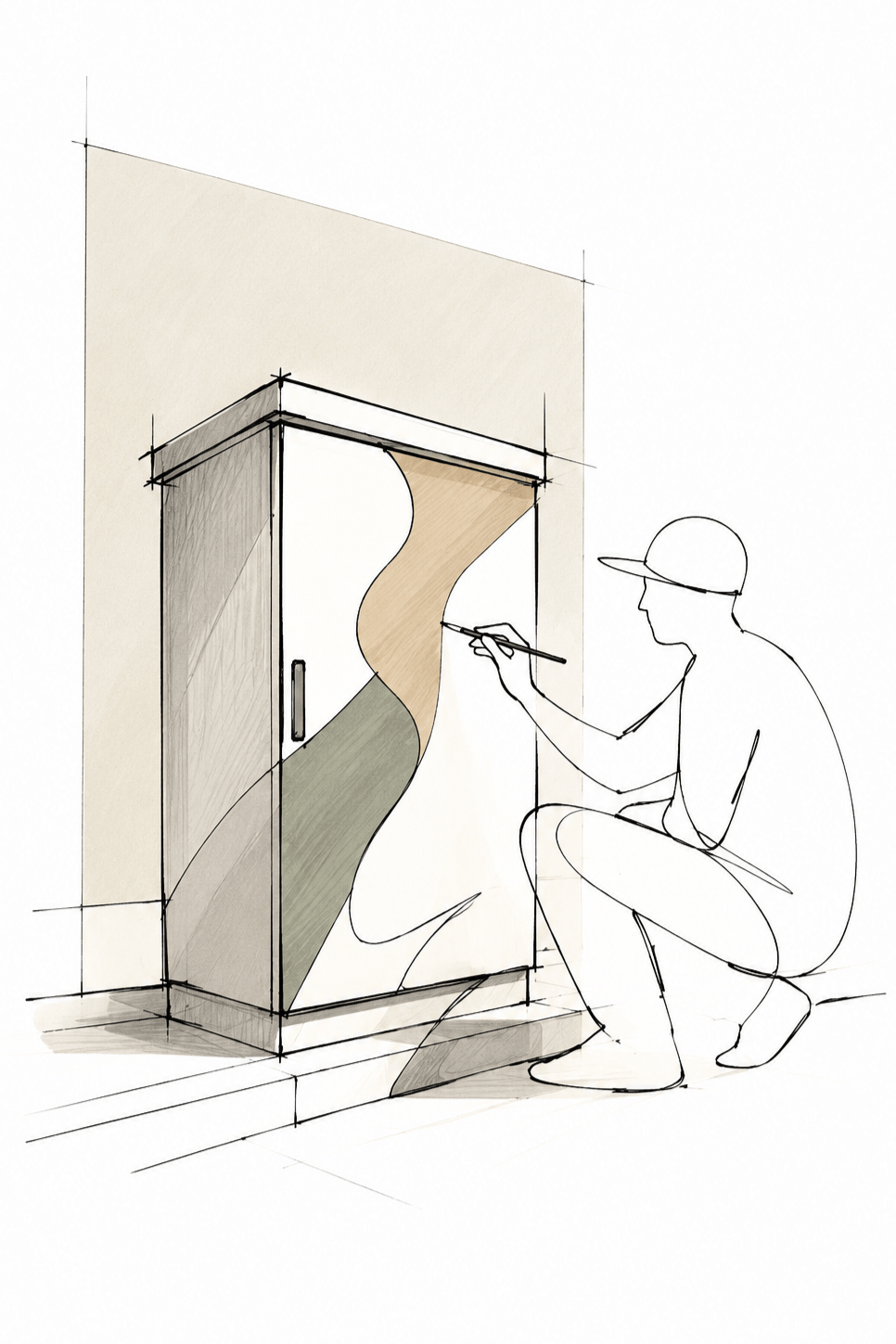
The murals on the KAFAO (the well-known outdoor metal telecommunications boxes of OTE) are a particularly interesting urban art initiative (street art), which has spread to many cities in Greece in recent years.
Its goal is to transform these gray, drab, and often vandalized boxes into small outdoor paintings.
Art in public spaces is culture.
It is expression, it is creation, it is life.
For this reason, such artistic interventions can be a particularly positive development for our cities.
As an architect, however, I feel the need to simply raise a point for consideration.
In architecture, even the smallest intervention in a building or public space requires adherence to rules, approvals, and, above all, respect for the environment in which it is situated.
These procedures often put our artistic nature to the test.
Yet it is a challenge to manage to create within the framework of a well-governed state.
Why shouldn’t the same principle apply to these visual art interventions as well?
Especially when they take place in areas with a strong historical and architectural identity, such as Marasia in Rhodes, where even the smallest interventions affect the overall character of the place.
We do not want to restrict creativity.
On the contrary, we want to challenge the artist to act creatively in a space that belongs to all of us.
Respect for public space does not limit art.
On the contrary, it allows art to shine, to endure, and to gain even greater value.
My concern is not just about the paintings themselves.
It concerns the message we send as a society.
If we accept that any intervention in public space can take place without a clear institutional and aesthetic framework, then where does it end?
Undoubtedly, public space needs more freedom in art.
Art that engages with the place and the people.
But public space is not a blank canvas.
It is our shared memory, our shared aesthetic, and ultimately, our shared responsibility.