The formation of a strong and well-informed unified voice for the Greek islands, both at the national and European levels, and making a decisive contribution to the European Strategy for Islands currently under development, is the goal of the third consecutive meeting of the Regional Governors of the South Aegean, George Hatzimarkos of the North Aegean, Konstantinos Moutzouris, and Yiannis Trepeklis of the Ionian Islands, which took place yesterday in Rhodes, as part of the close cooperation established in November 2024 in Corfu with the signing of the eponymous “Corfu Declaration.”
The meeting, which took place at the office of the Regional Governor of the South Aegean and President of the ENPE, at his invitation, was held in an emotional atmosphere, as everyone expressed their heartfelt condolences to the families of the firefighters who lost their lives in the line of duty in Rethymno and Gythio. For this reason, the Regional Governor of Crete, Stavros Arnaoutakis, was absent from the meeting in order to attend the funeral services; the next scheduled meeting of the four Regional Governors of the country’s island regions scheduled to take place in Crete
The main objective of the meeting, as explained by the Regional Governor of the South Aegean during a joint press conference that followed, is to join forces to ensure meaningful participation in the final form of the European Strategy for Islands (EU Island Strategy), which is currently being developed.
As Mr. Hatzimarkos emphasized, insular Greece constitutes Europe’s largest archipelago, and its united voice represents the main “firepower” at the European level, presenting a unified proposal from the National Union of Greek Islands (ENPE) comprising 13 key objectives. These include a standalone European strategy, a binding insularity clause, the adaptation of state aid rules, addressing demographic challenges, and ensuring energy and water sufficiency.
The three regional governors agreed that the unique characteristics of the islands, the increased operational needs of their infrastructure and services, geographical discontinuity, higher transportation costs, and the need to ensure equal access for residents to public goods require specially designed policies and consistent coordination.
The goal is to integrate insularity in a measurable and meaningful way into the design of national and European policies, the allocation of resources, and the financing of necessary projects and services. At the same time, the aim is to highlight the country’s insular character as a developmental advantage and as a testing ground for modern policies on sustainability, innovation, and resilience.
In welcoming his counterparts, George Hatzimarkos referred to the urgent need for cooperation and solidarity in a time of great challenges, emphasizing the importance of a unified stance toward Europe in shaping the Island Strategy. He emphatically pointed out that the island regions do not enter the European dialogue in a fragmented manner, but present themselves as a unified, strong national front.
“We are present in a way that—allow me to say—is not ‘Greek.’ That is to say, it is not four representatives of island regions with four different views and proposals. It is all of island Greece with common positions. All of island Greece represents by far the largest island group in Europe. A united island Greece is the driving force of island Europe, and not just of Greece,” he noted.
He made special mention of the exceptional convergence of circumstances unfolding on multiple levels: on the one hand, the appointment of Greek Finance Minister Kyriakos Pierrakakis as President of the Eurogroup, and, on the other hand, to Greece’s assumption of the Presidency of the European Union in the second half of 2027. As he explained, this juncture is critical because it is estimated that discussions on both the EU’s new Multiannual Financial Framework (2028–2034) and the Islands Strategy are very likely to be concluded precisely during the period when Greece holds the presidency, a fact that makes the Regions even more responsible for thorough preparation and advocacy.
Konstantinos Moutzouris, Regional Governor of the North Aegean, placed particular emphasis on the inequalities faced by the islands compared to mainland Greece, stressing that the simple concept of “insularity” is not enough, but that a focus on “micro-insularity” is required, noting that the general European “island policy” is designed for islands with millions of residents, such as Sicily or Corsica. He referred to the difficulties residents of small islands face in accessing healthcare and transportation, while also emphasizing the need to preserve primary production, tradition, and the national identity of remote regions
“What kind of island policy is there in Europe when in Italy we have Sardinia and Sicily, with populations in the millions, or in France we have Corsica, with a population in the millions, and in Greece we have the islands of Agios Efstratios? But here we have islands, and we intend to keep them. We will not cede them to anyone, not even to our neighbors to the east. So what Greece needs is not just an island policy, but also a policy for small islands. That is where our problem lies. “We will strive to stand together—for in unity lies strength, and in unity lie our demands and the achievement of our goals—despite our differences, because sometimes diversity is also a source of wealth,” he stated, among other things.
Yiannis Trepeklis, Regional Governor of the Ionian Islands, highlighted the pressing issue of the housing crisis as a serious threat to social cohesion on the islands, painting a grim picture of how the lack of affordable housing leads to a shortage of staff in hospitals, schools, and law enforcement agencies. He presented as a major national success of the alliance of island regions the fact that, through coordinated interventions in European Parliament committees, they succeeded in placing the housing problem on the European agenda. This pressure led to the inclusion, for the first time, of social housing into co-funded programs for the first time—a policy that now paves the way for the construction of low-rent housing for public servants. Furthermore, he sounded the alarm about the climate crisis, noting the unprecedented damage to infrastructure and the natural environment (such as landslides and the destruction of centuries-old olive groves in Corfu) and emphasized the significantly greater time and cost required for their restoration on the islands. Finally, he made special mention of the struggle to preserve the unique cultural identity of the tourist islands, welcoming the removal of bureaucratic obstacles that now allows for the funding of cultural exchanges between regions.
“Teachers aren’t showing up at schools. We’re subsidizing our employees in the regional units with 500 euros, and they still aren’t coming. The state is literally collapsing in the island regions. We won’t be able to find firefighters, police officers, or teachers. We may have thriving economies—I have a good income—but in September, my grandson can’t find a school or a teacher. So what have we achieved as a society and as a policy? We worked toward this goal, I served on three committees in the European Parliament and the European Commission. Together with an alliance and other Mediterranean island regions, we lobbied successfully, and that’s how funding for affordable housing. “It didn’t exist; we made it happen!” he stated, among other things.
The political message
At the conclusion of the meeting, Mr. Hatzimarkos also highlighted the recent inclusion of social housing as an official policy eligible for funding from European resources as a tremendous collective victory, an achievement made possible by the joint advocacy of the Regions. However, the strongest political message he conveyed concerned the need for a definitive break with the pathologies of the past. Recognizing the frequent internal rivalries between islands, which are fueled by a deeply rooted “politics of division,” he set as an intangible, sacred goal the building of a shared island consciousness.
“This isn’t a step; it’s a leap. It’s a leap that came about only when we all sat down at the same table, understood one another, united, joined hands, and worked together toward the same goal: building a shared consciousness. It is an intangible goal, but it is sacred. It is the greatest, the most ambitious, and it requires hard work,” he concluded.
“4 Regions, One Vision”
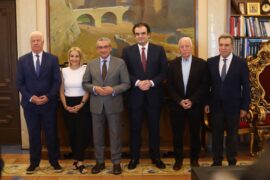
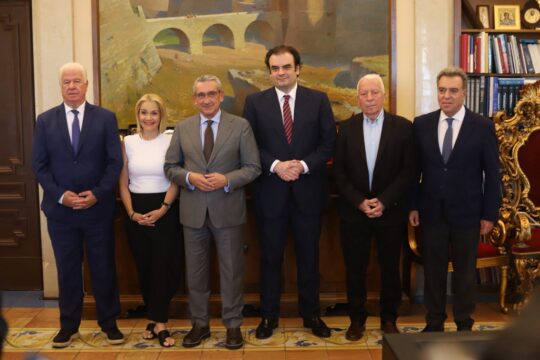
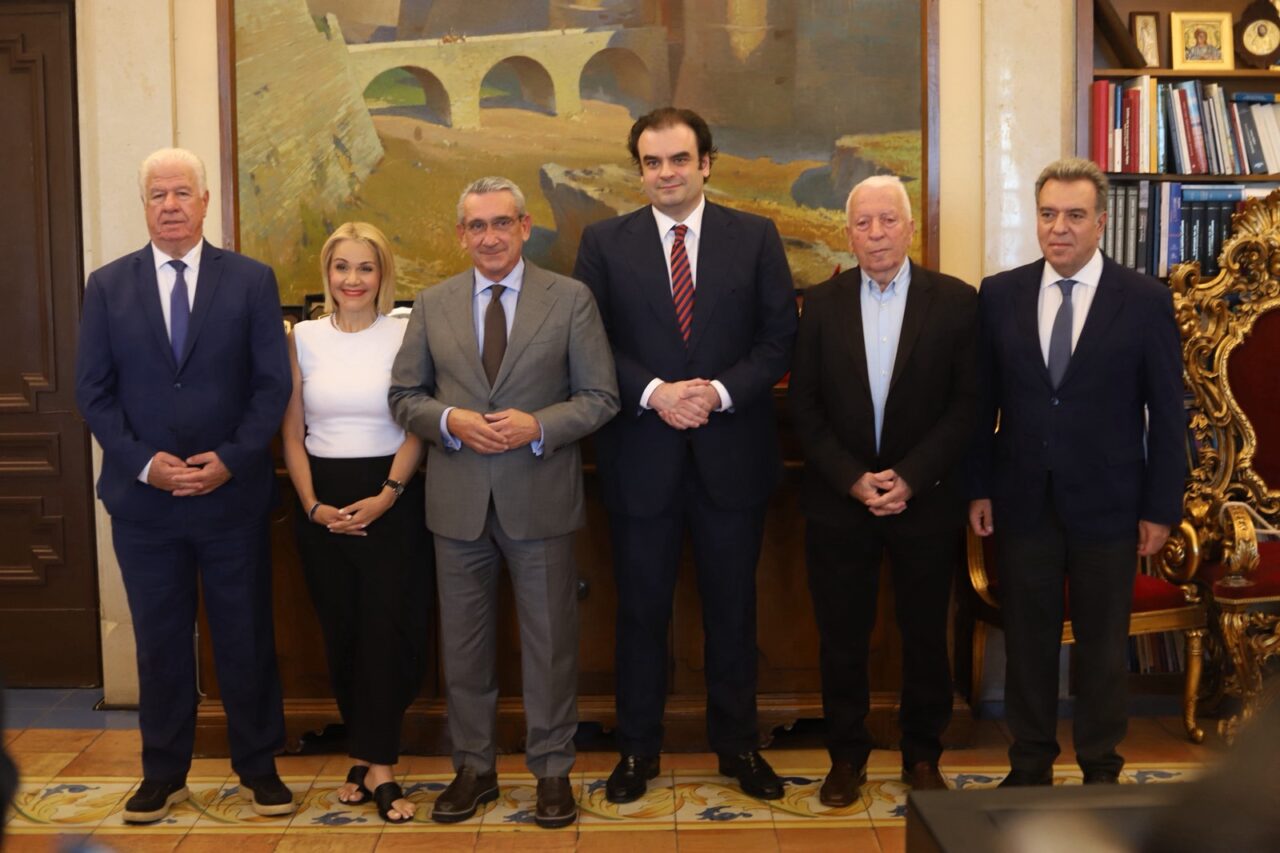
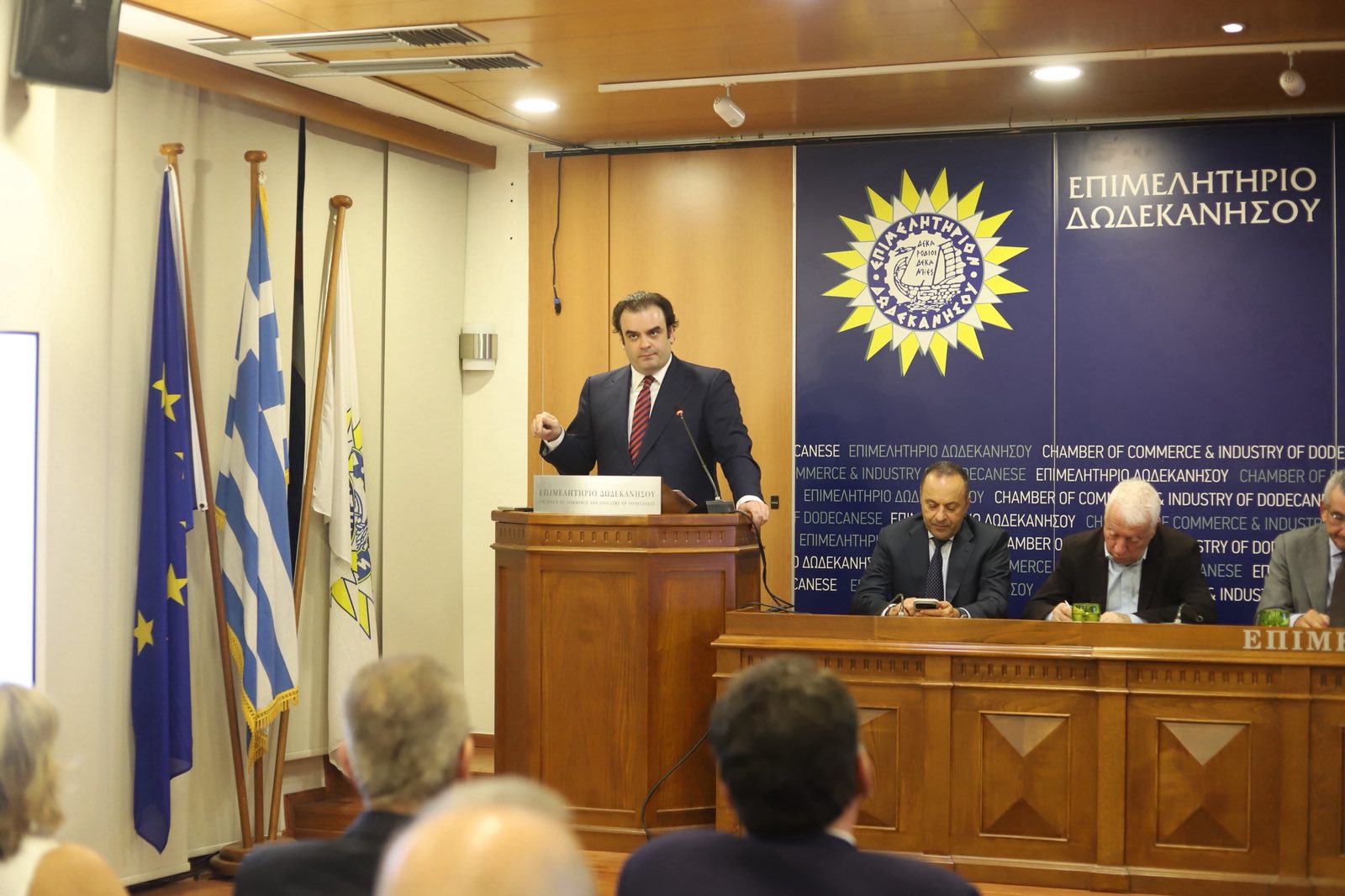
Yesterday afternoon, the three regional governors presented their positions during an event at the Chamber of Commerce in Dodecanese, titled “4 Regions, One Vision,” with Kyriakos Pierrakakis, Minister of National Economy and Finance and President of the Eurogroup, as the keynote speaker. The event was organized by the country’s four island regions in collaboration with the Chamber of Commerce of Dodecanese, the Technical Chamber of Greece, and the Economic Chamber of Greece. Earlier that afternoon, Regional Governor George Hatzimarkos welcomed Mr. Pierrakakis to his office, in the presence of the two Regional Governors of the North Aegean and the Ionian Islands, as well as Manos Konsolas and Mikas Iatridis, members of parliament from the ruling party.
 The 13 Proposals for the European Strategy for Islands
The 13 proposals that the country’s island regions are calling for to be included in the European Strategy for Islands are as follows:
- A Standalone and Clearly Defined European Strategy for Islands
The new strategy must have a distinct character, a clear scope, specific objectives, monitoring indicators, and adequate financial support. Insularity cannot be addressed in a piecemeal manner or as an appendix to broader territorial policies, but requires a coherent and permanent European framework for action.
- Establishment of a binding insularity clause and an “island-proofing” mechanism
The ENPE considers it necessary to establish a mandatory assessment of the impact of every European policy, legislative proposal, or funding instrument on island regions. The principle of insularity must be given practical and binding substance, with its practical integration into sectors such as transportation, energy, the internal market, digital policy, competition, the environment, and tourism.
- A Strong Cohesion Policy after 2027 with a Specific Island Dimension
Cohesion Policy must remain the key funding and development tool for Europe’s islands. The new programming period must include specific resources, tailored criteria, and targeted funding instruments for island regions, while fully safeguarding the partnership and multilevel governance. Regions must play a substantive role in the design, implementation, monitoring, and evaluation of policies affecting the islands.
- Special attention must be given to small, very small, remote, and archipelagic islands
The European strategy must include a dedicated pillar for islands facing greater challenges due to their size, population scale, geographical isolation, administrative weaknesses, and higher costs of access to basic services. For these regions, higher aid intensities, flexibility in eligibility criteria, technical assistance, and simplified procedures are required.
- Connectivity as a Prerequisite for Cohesion, Equality, and Development
Accessibility to the islands must be recognized as a fundamental condition for equal participation in the economic and social life of the Union. The strategy must include robust measures for maritime, air, inter-island, and digital connectivity, as well as for the upgrading of port, airport, and telecommunications infrastructure. At the same time, the green transition in transportation must be accompanied by compensatory measures to ensure that disproportionate costs are not passed on to the islands, their residents, and businesses.
- Adaptation of State Aid Rules and Recognition of the Costs of Insularity
The ENPE recommends reforming the European state aid framework, including the de minimis rules, the General Block Exemption Regulation, and regional aid, to take into account the permanent, measurable, and structural additional costs of insularity. Island businesses, services of general interest, and critical infrastructure cannot be assessed under the same conditions that apply to mainland regions.
- Energy security, water sufficiency, and climate resilience
The new strategy must include a strong pillar for the energy transition and resilience of islands, with measures for electrical interconnections, energy storage, energy communities, the utilization of renewable sources, energy self-sufficiency, and the fight against energy poverty. Similarly, special attention must be given to water scarcity, sustainable water resource management, reuse, desalination where necessary, the prevention of natural hazards, and the overall adaptation of the islands to climate change.
- Support for economic diversification and the blue economy
The islands should not be viewed solely as areas with disadvantages, but also as territories with significant potential and strategic advantages. The ENPE proposes specific policies for the blue economy, sustainable fisheries, and aquaculture, local agri-food production, innovation, research, digital transformation, the circular economy, and the integration of the islands into European value chains.
- Sustainable, high-quality, and balanced tourism
The ENPE advocates for the inclusion of a specific island dimension in European tourism policies, with an emphasis on quality, the diversification of tourism products, links to the local economy, culture, agri-food, and the strengthening of infrastructure that supports the cohesion of local communities. Tourism development on the islands must be compatible with the goals of environmental protection, social balance, and long-term economic resilience.
- Social cohesion, demographic sustainability, and access to essential services
The strategy must support residents’ right to remain on and build lives on their islands. To this end, it is necessary to improve access to health care, education, social care, housing, telemedicine, training, and employment, with particular attention to young people, families, the elderly, and vulnerable social groups.
- Special provisions for frontline islands and regions facing increased external pressures
Certain Greek islands face additional pressures due to their geographical location and their role on the European Union’s external borders. The strategy must provide for enhanced European support for these regions, both in terms of infrastructure and services and in terms of administrative and social resilience.
- Island Status Observatory and Strengthening Policy Evidence
The ENPE proposes the creation of a European mechanism for monitoring insularity and generating specialized data, with appropriate indicators for accessibility, cost of living, cost of insularity, demographics, energy situation, public services, and development attractiveness. The lack of adequate and comparable data acts as a barrier to evidence-based policymaking.
- Adapting European cooperation tools to maritime and island realities
Territorial cooperation, transnational and interregional partnerships, and cooperation funding programs must take the specific characteristics of the maritime space into serious account. Current geographical and distance-based criteria often exclude island regions from natural partnerships and functional collaborations. The ENPE considers it necessary to revise these conditions in favor of a more realistic and functional approach.